
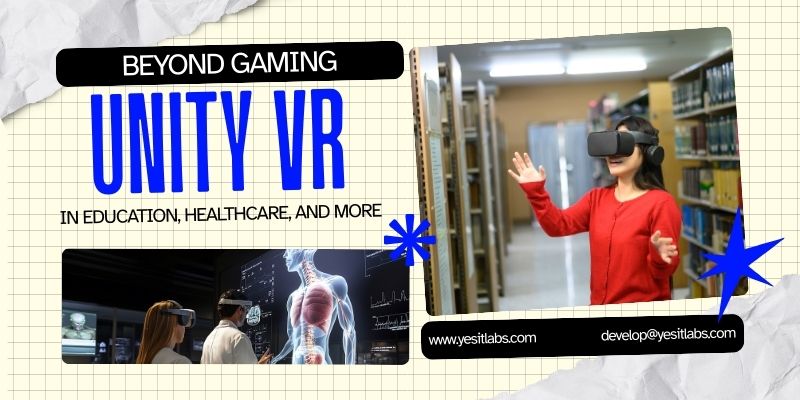
Virtual reality is no longer a novelty reserved for entertainment. It is becoming a practical tool that helps people learn faster, practice safely, and make better decisions. At the center of this shift is Unity, a platform that makes immersive experiences accessible to educators, healthcare professionals, businesses, and designers. The real story of Unity VR is not about technology alone. It is about how people use it to solve real problems.
Why Unity VR resonates beyond gaming
Unity stands out because it removes friction between ideas and execution. Teams can move from concept to working experience quickly, test with real users, and refine without starting over. Many organizations that already rely on Unity game development services discover that the same tools translate naturally into training, simulation, and visualization projects.
What makes Unity especially appealing is flexibility. It works across devices, supports long-term updates, and allows organizations to grow their VR initiatives at a pace that feels realistic rather than overwhelming.
Education: learning that feels real
Education changes when students stop watching and start doing. Unity VR makes this possible by turning lessons into experiences.
Students can explore virtual science labs, interact with complex anatomy, or step into historical environments instead of just reading about them. These experiences feel closer to real life, which helps concepts stick. Learners are not just memorizing information. They are building understanding through action.
Institutions are increasingly investing in Education App Development Services because adding VR boosts student engagement and confidence. Learners often feel more motivated and less intimidated when they can practice skills in a safe, immersive environment where mistakes are a natural part of the learning process.
Healthcare: safer practice, more confident care
In healthcare, preparation matters. Unity VR gives professionals a way to practice without putting patients at risk.
Doctors, nurses, and emergency teams can rehearse procedures, improve coordination, and build muscle memory before facing real-world situations. Patients also benefit. VR is used for pain distraction, anxiety reduction, and rehabilitation exercises that feel more engaging than traditional routines.
Organizations working with a healthcare software development company in USA are adopting Unity VR because it combines realism with measurable outcomes. Training progress, reaction times, and consistency can all be tracked, giving teams clear insight into improvement over time.
Corporate and industrial training that actually sticks
Traditional training often struggles to hold attention. Unity VR changes that by placing employees inside realistic scenarios where decisions matter.
Companies use VR to teach safety procedures, equipment operation, and even communication skills. Practicing these situations in a virtual environment helps employees feel prepared rather than anxious when similar moments happen on the job.
When Unity VR is integrated with existing elearning portal development services, it becomes part of a complete learning journey. Short VR sessions complement courses and assessments, creating training programs that feel practical instead of theoretical.
Architecture and design: seeing before building
Design decisions are easier when you can walk through a space before it exists. Unity VR allows architects, designers, and clients to experience scale, flow, and functionality in a way drawings cannot match.
This shared understanding reduces misunderstandings, speeds up approvals, and prevents costly changes later. It also builds trust because everyone sees the same vision from the start.
Measuring value in human terms
Return on investment is important, but the real value of Unity VR often shows up in everyday outcomes.
Organizations report:
- Faster readiness and skill confidence
- Fewer errors during real-world tasks
- Higher engagement and completion rates
- Reduced risk during training
- Stronger understanding of complex concepts
These improvements translate into saved time, reduced stress, and better results for both learners and professionals.
Designing experiences people want to use
Successful Unity VR projects focus on people first.
Comfort, clarity, and accessibility matter more than visual spectacle. Smooth performance, intuitive interactions, and options for different user needs make experiences welcoming rather than intimidating. When users feel comfortable, they stay engaged and learn more effectively.
Challenges and thoughtful adoption
Adopting VR does come with challenges. Costs, user hesitation, and system integration can slow progress. The most successful teams start small, listen to feedback, and grow intentionally. By involving real users early and focusing on one meaningful goal, organizations build momentum instead of resistance.
What the future looks like
As VR becomes more familiar, Unity VR will feel less like new technology and more like a natural part of learning and professional development. Smarter simulations, personalized experiences, and deeper analytics will continue to improve how people train and collaborate.
Conclusion
Unity VR is not about replacing traditional methods. It is about enhancing them in ways that feel human and practical. In classrooms, hospitals, workplaces, and design studios, it helps people practice with confidence, learn with purpose, and make better decisions. When used thoughtfully, Unity VR becomes more than a tool. It becomes a bridge between knowledge and real-world action.