

Enterprise software development has changed rapidly over the last decade. Businesses must launch faster, support multiple platforms, and still deliver smooth digital experiences. Maintaining separate codebases for iOS, Android, web, and desktop increases development time and operational costs. This growing complexity is one of the main reasons many enterprises are shifting toward Flutter.
Flutter is a cross-platform framework developed by Google that enables teams to build applications for multiple platforms using a single codebase. What started as a mobile framework has evolved into a full solution for mobile, web, and desktop environments. Today, enterprises are adopting Flutter to improve speed, consistency, and long-term efficiency.
Enterprise adoption in numbers
Flutter’s growth is backed by strong industry adoption and developer interest.
- Flutter consistently ranks among the most popular cross-platform frameworks in global developer surveys.
- High-profile companies such as Google Pay, Alibaba, BMW, eBay, and Dream11 use Flutter in production.
- These applications serve millions of users and manage complex workflows, proving Flutter’s reliability at scale.
This combination of community support and enterprise trust makes Flutter a low-risk choice for long-term projects.
Faster time to market with one codebase
One of Flutter’s strongest advantages is its shared codebase across platforms. Instead of building separate native apps, enterprises can maintain one unified development process.
Key business benefits include:
- Simultaneous feature releases on Android and iOS
- Reduced testing and quality assurance duplication
- Simplified project management and deployment cycles
Because of these efficiencies, many providers offering flutter mobile app development services are able to deliver solutions more quickly without compromising on quality or performance.
High performance that feels native
Performance concerns are common when evaluating cross-platform frameworks. Flutter addresses this issue by compiling code directly into native machine code and using a dedicated rendering engine.
From a user perspective, this means:
- Smooth animations and transitions
- Responsive touch interactions
- Consistent frame rates similar to native applications
For enterprises building customer-facing platforms, maintaining a fast and fluid interface is essential for usability and customer satisfaction.
Consistent design and brand experience
Enterprises invest heavily in brand identity and user interface design. However, keeping the same look and feel across different platforms is challenging when using native development separately.
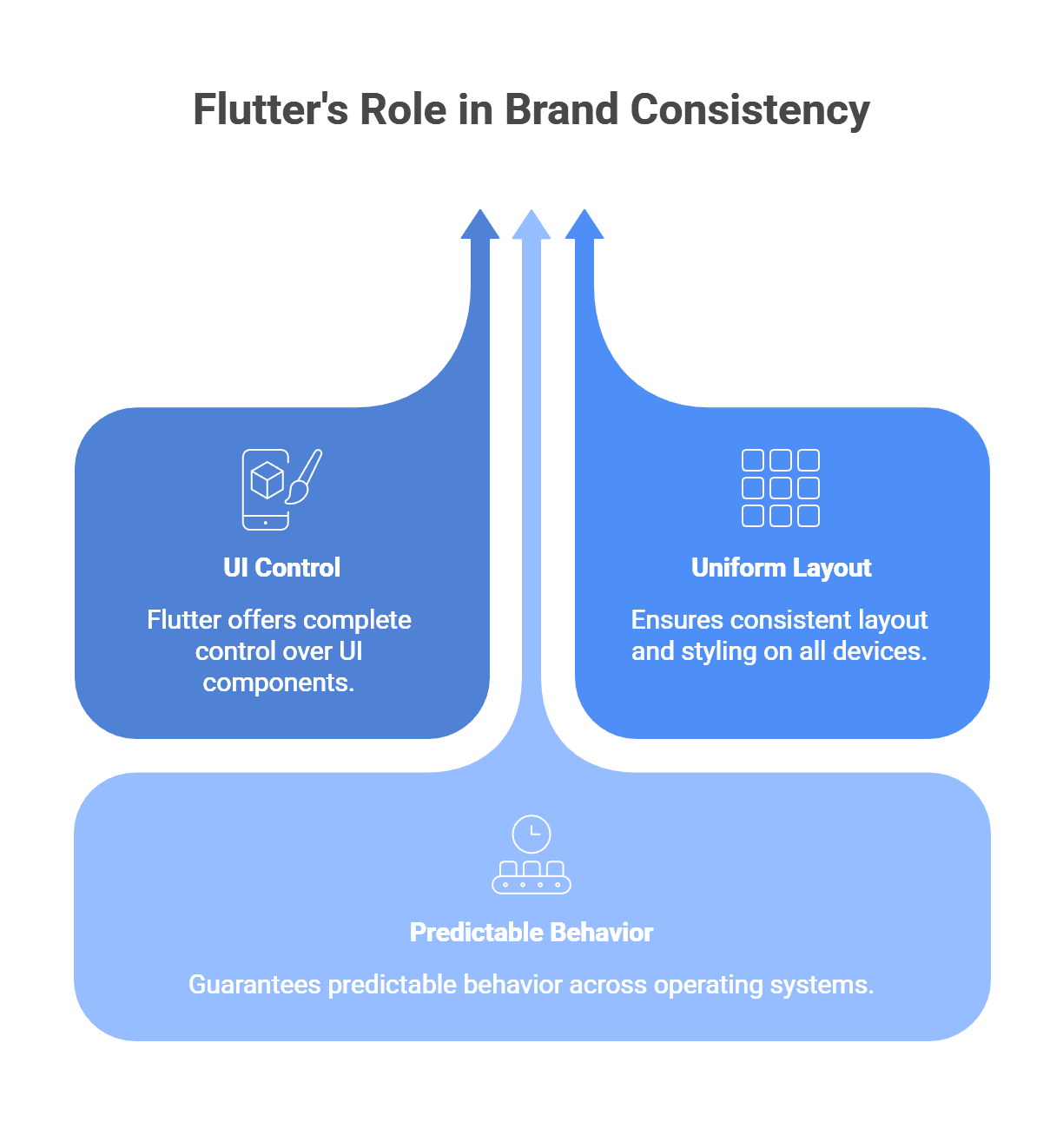
Flutter provides:
- Full control over UI components
- Uniform layout and styling across devices
- Predictable behavior across operating systems
As a result, organizations involved in cross platform applications development in USA often prefer Flutter because it ensures their applications present a consistent visual identity regardless of device or platform.
Strong developer productivity
Flutter is designed to reduce development friction and increase output.
Its productivity advantages include:
- Hot reload for instant preview of changes
- Modern debugging and profiling tools
- A growing ecosystem of reusable libraries
These tools allow teams to prototype faster, test more effectively, and collaborate more closely with designers and product managers. Over time, this leads to shorter development cycles and improved innovation capacity.
Mature ecosystem and long-term support
Flutter benefits from long-term backing by Google and an active global open-source community.
This support translates into:
- Regular updates and security improvements
- Libraries for testing, localization, analytics, and accessibility
- Expanding availability of skilled developers
As more enterprises adopt Flutter, it becomes easier to hire flutter developer talent with experience in large-scale projects and enterprise-grade systems.
Proven success in real-world enterprise apps
Flutter is no longer limited to experimental or small-scale projects. It is used in real-world applications with demanding technical and business requirements.

Examples include:
- Google Pay using Flutter for parts of its mobile interface
- Alibaba implementing Flutter in high-traffic customer platforms
- BMW integrating Flutter into automotive and companion applications
These success stories show that Flutter can handle complex interfaces, strict performance needs, and millions of users simultaneously.
Cost efficiency and easier maintenance
From a financial standpoint, Flutter helps enterprises reduce long-term costs.
Key cost-related advantages include:
- One codebase instead of multiple native versions
- Faster bug fixes and feature updates
- Lower maintenance and support overhead
This results in a lower total cost of ownership over time and allows organizations to redirect resources toward product innovation instead of platform duplication.
Challenges enterprises should consider
While Flutter offers many benefits, it is important to assess potential challenges before adoption.
Common considerations include:
- Some device-specific features still require native code integration
- Application size can be slightly larger than minimal native builds
- Teams may need training in Dart and Flutter workflows
These factors are manageable but should be planned for early in the adoption process.
How enterprises typically adopt Flutter
Most organizations follow a gradual and controlled approach when introducing Flutter.
Common adoption strategies include:
- Building new applications entirely in Flutter
- Migrating selected features from existing native apps
- Using Flutter first for internal tools and dashboards
This phased method allows enterprises to evaluate performance, development speed, and maintenance benefits without disrupting existing systems.
Final thoughts
Flutter has become a strong and practical choice for enterprise application development. It offers a balance of development efficiency, high performance, and consistent user experience across platforms. Its growing ecosystem and proven enterprise use cases demonstrate that it is capable of supporting complex, large-scale applications.
Enterprises are choosing Flutter because it helps them move faster, control costs, and deliver reliable digital experiences across devices. With careful planning and technical evaluation, Flutter provides a forward-looking foundation for modern enterprise software strategies.