
When a business starts growing, inventory quickly becomes one of the biggest operational challenges. In the early days, many companies managed stock with spreadsheets or simple tracking tools. At first, this worked fine. But as orders increase, products expand, and warehouses multiply, those manual systems start to break down.
Suddenly teams are dealing with missing stock, delayed orders, and inaccurate inventory counts. These problems slow down growth and frustrate both employees and customers.
That is why more growing companies are investing in custom inventory management software. Instead of forcing their operations into rigid tools, they build systems designed specifically for how their business actually works.
For businesses planning long term expansion, the right inventory technology is not just helpful. It is essential.
What Inventory Management Software Actually Does
Inventory management software helps businesses monitor and control their products throughout the entire supply chain. From purchasing raw materials to shipping finished goods, the software keeps track of where every item is located and how much stock is available.
Modern systems usually include tools for:
- Tracking stock levels in real time
- Managing purchase orders and suppliers
- Monitoring warehouse movement
- Forecasting product demand
- Generating reports for inventory performance
With accurate visibility, businesses can avoid common problems like overstocking slow moving products or running out of popular items during peak demand.
Many growing companies eventually work with an inventory management software development company to create systems tailored specifically to their workflows, inventory types, and operational needs.
Why Custom Inventory Management Software Helps Businesses Scale
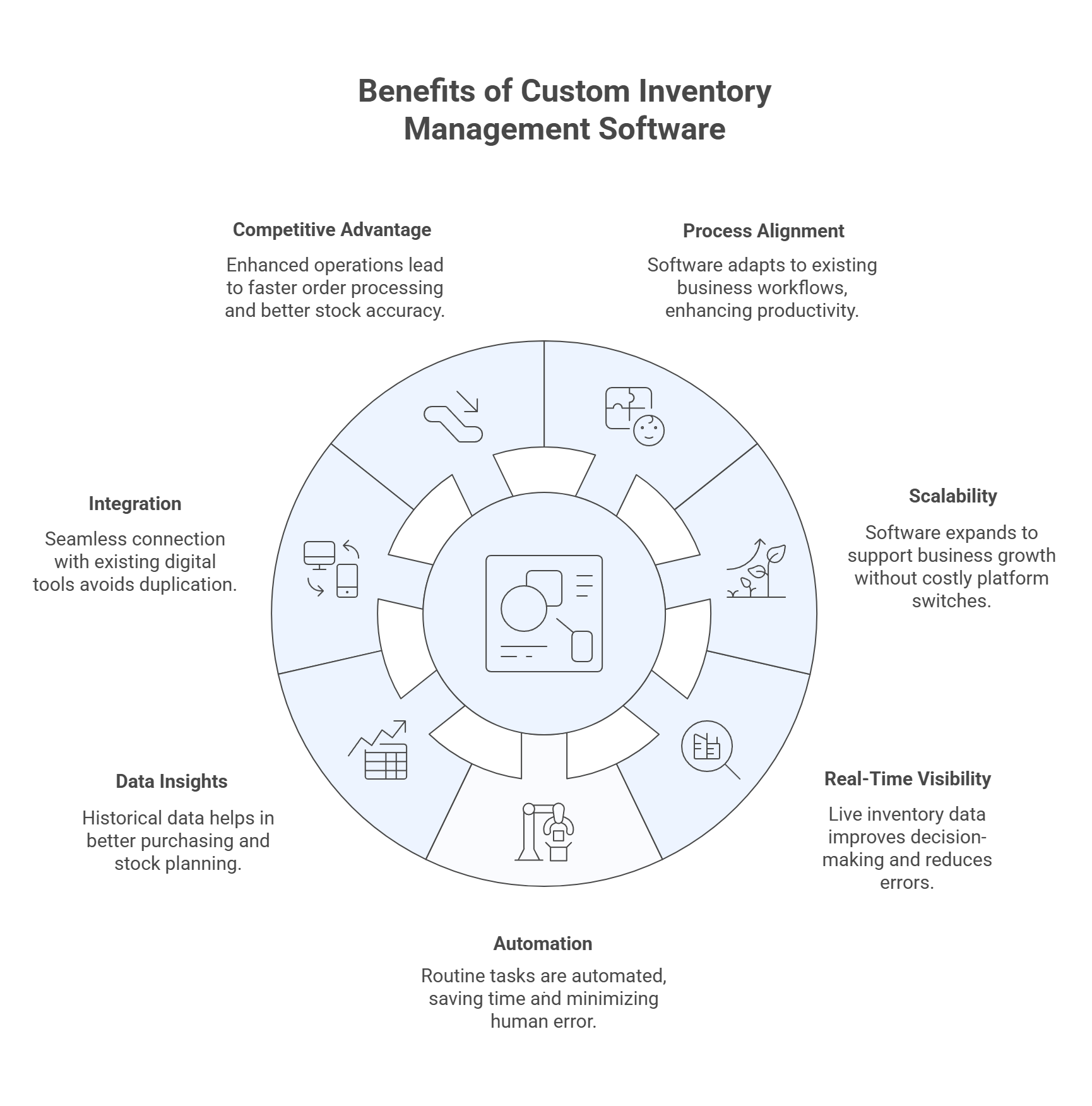
1. It Matches Your Actual Business Processes
No two businesses handle inventory the same way.
A retail brand selling clothing online manages inventory very differently from a manufacturing company producing equipment parts. Off the shelf tools try to serve everyone, which often means they are not perfectly suited for anyone.
Custom inventory software removes that limitation.
Instead of adapting your operations to the software, the software adapts to your operations. That means your system can include:
- Custom warehouse workflows
- Product specific tracking methods
- Specialized inventory categories
- Unique reporting dashboards
When the technology fits the way your company already works, employees spend less time struggling with tools and more time focusing on productivity.
2. It Grows Alongside Your Business
Growth is great, but it also creates complexity.
A company that once managed a few hundred products might suddenly need to track thousands. New warehouses open. Online sales channels expand. Suppliers multiply.
Without the right system, inventory becomes difficult to manage.
Custom software is designed with scalability in mind. As your company grows, developers can expand the system to support new warehouses, new product lines, or higher transaction volumes.
That flexibility helps businesses avoid the expensive process of switching platforms every few years.
3. Real Time Visibility Improves Decision Making
One of the biggest frustrations for business owners is not knowing the true status of their inventory.
Without real time data, teams often rely on outdated reports or manual checks. That leads to mistakes such as selling products that are already out of stock or ordering items that are already sitting in the warehouse.
Custom inventory systems solve this problem by providing a live view of inventory across all locations.
With accurate information, businesses can:
- Respond faster to customer orders
- Reduce stock shortages
- Avoid unnecessary inventory costs
- Improve overall operational efficiency
In fast moving industries like ecommerce, this level of visibility makes a huge difference.
4. Automation Saves Time and Reduces Errors
Manual inventory management is surprisingly time consuming. Employees often spend hours updating spreadsheets, checking stock levels, or verifying purchase orders.
Even small mistakes can create major problems.
Custom inventory software helps eliminate these issues by automating routine processes such as:
- Reordering products when stock reaches a minimum level
- Updating inventory after every sale
- Tracking shipments from suppliers
- Generating reports automatically
Automation not only saves time but also reduces the chance of human error.
Over time, these improvements can significantly reduce operational costs.
5. Data Insights Help Businesses Plan Better
Inventory systems are not just about tracking products. They are also powerful sources of business data.
Custom solutions can analyze historical sales, seasonal demand patterns, and product performance. This allows businesses to make more informed decisions about purchasing and stock planning.
For example, companies can quickly identify:
- Which products sell fastest
- Which items sit in storage too long
- When seasonal demand spikes occur
- Which suppliers perform reliably
With better data, businesses can plan inventory strategies that support growth instead of limiting it.
6. Integration With Your Existing Digital Tools
Most businesses rely on several digital platforms to operate. These may include accounting software, customer management systems, ecommerce platforms, and internal reporting tools.
Inventory systems work best when they connect smoothly with all of these platforms.
For instance, many companies run their websites using content management systems like WordPress. Working with a reliable wordpress development company can help ensure inventory data syncs correctly between the website, backend operations, and other business tools.
When systems communicate with each other properly, teams avoid duplicate work and reduce operational confusion.
7. Competitive Advantage Through Better Operations
Operational efficiency can be a powerful competitive advantage.
Companies with well designed inventory systems can process orders faster, maintain better stock accuracy, and respond quickly to changes in demand.
Custom software also allows businesses to add advanced capabilities such as:
- Intelligent demand forecasting
- Automated warehouse management
- Real time sales tracking
- Custom fulfillment workflows
These capabilities help companies stay ahead of competitors that rely on outdated inventory processes.
Key Features of Effective Custom Inventory Systems
While every business has unique requirements, most custom inventory platforms include several essential features.
Real Time Inventory Tracking
Businesses can monitor stock levels instantly across warehouses, retail locations, and online stores.
Automated Reordering
The system automatically alerts teams or places orders when inventory falls below predefined thresholds.
Barcode or RFID Integration
Scanning tools simplify product tracking and reduce manual entry errors.
Warehouse Management
Products can be organized and tracked by location, aisle, or storage area.
Reporting and Analytics
Custom dashboards help managers understand inventory performance and operational trends.
Industries That Benefit Most From Custom Inventory Systems
Many industries rely heavily on accurate inventory management, including:
- Ecommerce retailers
- Manufacturing companies
- Wholesale distributors
- Retail chains
- Logistics providers
- Healthcare suppliers
For ecommerce businesses in particular, integrating inventory systems with online stores is critical. Companies that invest in Shopify development services in USA often connect their Shopify platforms directly with custom inventory tools to maintain accurate product availability and avoid overselling.
Custom vs Off the Shelf Inventory Software
| Feature | Custom Software |
Off the Shelf Software |
| Customization |
Fully tailored to business workflows |
Limited flexibility |
| Scalability |
Designed to grow with the business |
May require switching systems |
| Integration |
Built for seamless integration |
Often requires workarounds |
| Initial Cost |
Higher upfront investment |
Lower initial cost |
| Long Term Value |
Higher ROI for growing companies |
Limited long term scalability |
For small startups, off the shelf tools may be enough. But once a company begins expanding rapidly, custom systems usually offer better long term value.
The Future of Inventory Management
Technology continues to reshape how businesses manage inventory. New innovations are already changing supply chains across industries.
Some of the most important trends include:
- Artificial intelligence for demand forecasting
- Internet of Things devices for product tracking
- Cloud based inventory platforms
- Automated warehouse systems
- Advanced supply chain analytics
Businesses that adopt flexible and scalable inventory solutions today will be better prepared to take advantage of these technologies in the future.
Conclusion
Growing a business successfully requires more than increasing sales. It requires strong operational systems that can handle increasing complexity.
Inventory management plays a central role in that process. Without accurate stock tracking and efficient workflows, growth can quickly create operational bottlenecks.
Custom inventory management software gives businesses the flexibility, visibility, and automation needed to manage inventory effectively at scale.
Companies that invest in the right inventory technology position themselves for smoother operations, stronger customer experiences, and sustainable long term growth.