
CodeIgniter development is productive because it strips away the unnecessary complexity that slows down most PHP projects. It gives developers a lightweight, straightforward environment where they can build functional, scalable web applications without fighting the framework itself. For teams working under tight deadlines or budget constraints, that simplicity translates directly into faster delivery and lower development cost.
What Makes a PHP Framework Truly Productive?
Productivity in web development is not just about writing less code. It is about how quickly a team can go from requirements to a working product, how easy it is to debug when things go wrong, and how maintainable the codebase is six months down the line.
Most PHP frameworks add layers of abstraction that are genuinely useful at enterprise scale but become friction for small to mid-size projects. Configuration files, dependency injection containers, complex ORM setups, and opinionated folder structures all take time to learn and time to manage.
CodeIgniter was designed with a different philosophy. The core library is small. The documentation is clear. A developer with basic PHP knowledge can be productive on a CodeIgniter project within a day or two. That learning curve difference is not trivial. It directly affects how fast a business can staff a project, onboard new developers, and ship features.
Why CodeIgniter Development is Productive Compared to Laravel, Symfony, and Others
The productivity gap between CodeIgniter and heavier frameworks like Laravel or Symfony becomes obvious when you look at what each framework requires before you can write a single line of business logic.
- Laravel, for all its elegance, requires a firm understanding of Eloquent ORM, service providers, facades, Artisan commands, and Blade templating before a developer can work effectively. Symfony is even more configuration-heavy. These frameworks reward teams that invest serious time upfront. That investment pays off at scale, but it also means a longer runway before the project gains momentum.
- CodeIgniter asks for far less upfront. The MVC structure is simple and logical. The helper functions cover most common tasks. Database queries can be written using the Query Builder class without learning a full ORM. Session handling, form validation, file uploads, and caching all work without additional packages or configuration.
According to W3Techs data, PHP powers over 77 percent of all websites with a known server-side language. Within that space, CodeIgniter consistently ranks among the top frameworks for small to mid-size applications precisely because of this productivity advantage. (source)
Side-by-Side Comparison At what Each Major Framework Demands
| Framework |
Setup Time |
Learning Curve | Best For |
Performance (Simple Apps) |
| CodeIgniter |
Low |
Gentle | SMB apps, portals, APIs |
Very Fast |
|
Laravel |
Medium-High | Steep | Enterprise, large teams |
Moderate |
|
Symfony |
High | Very Steep | Complex enterprise systems |
Moderate |
| Yii2 |
Medium |
Moderate | Mid-size projects |
Fast |
| CakePHP |
Medium |
Moderate | Rapid prototyping |
Moderate |
The pattern is clear. CodeIgniter wins on speed to productivity, especially for projects that do not need the full weight of an enterprise framework.
Key Reasons CodeIgniter Outperforms Other PHP Frameworks on Productivity
Minimal Configuration, Maximum Output
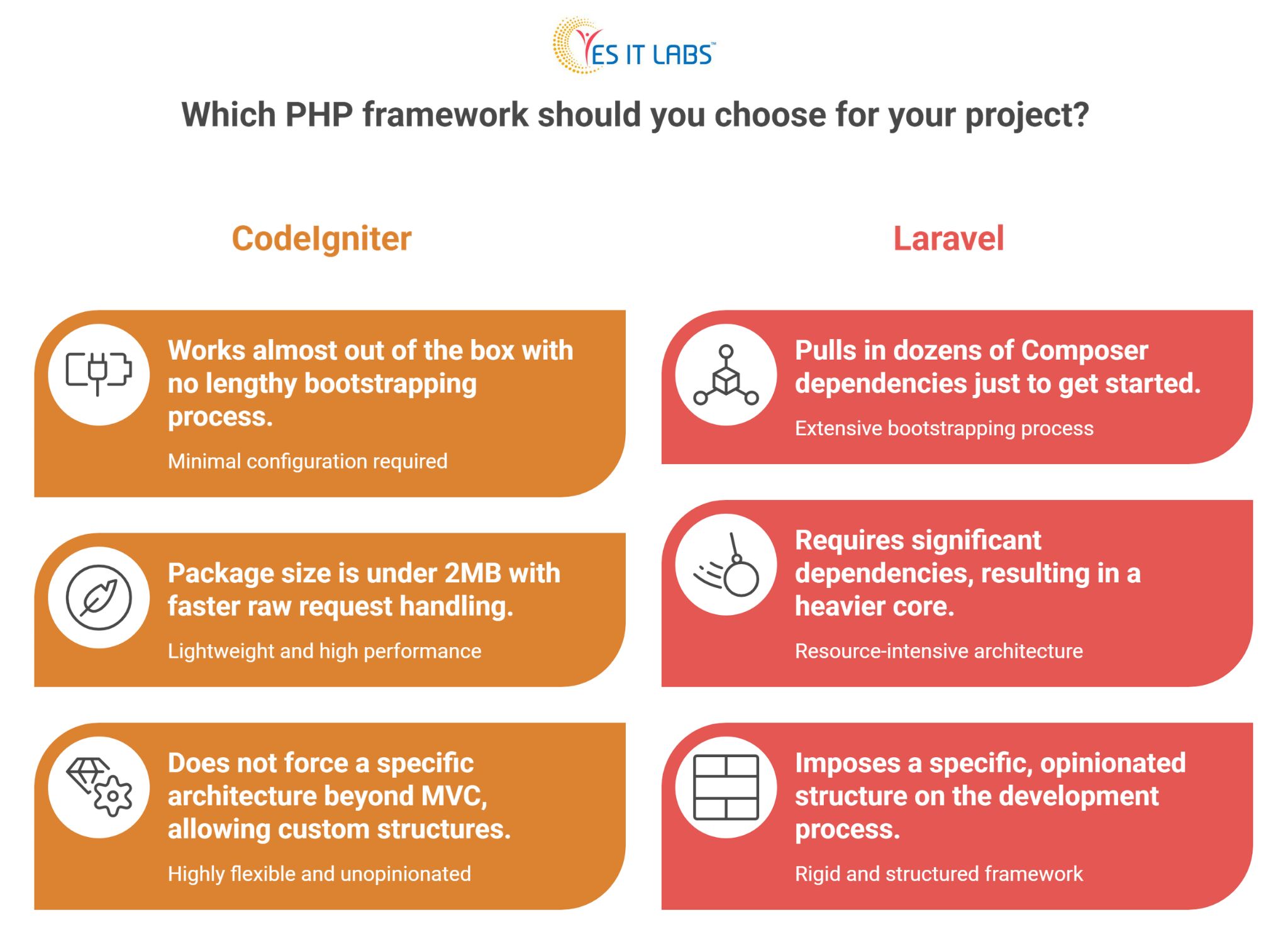
One of the most underrated things about CodeIgniter is that it works almost out of the box. There is no lengthy bootstrapping process. Developers configure what they need and leave the rest alone. This is a direct productivity gain because teams spend time building features, not configuring the environment.
Lightweight Footprint
The CodeIgniter package is under 2MB. Compare that to Laravel, which pulls in dozens of Composer dependencies just to get started. A lighter core means faster load times, easier hosting, and simpler deployments. For projects like custom web portal development, where performance and scalability matter from day one, this is a real advantage.
Excellent Documentation
CodeIgniter’s official documentation has been praised consistently since version 1. It is thorough, well-organized, and genuinely written for developers rather than to impress stakeholders. When a developer hits a problem, the documentation usually has the answer. This cuts down debugging time significantly.
Flexible, Not Opinionated
CodeIgniter does not force a specific architecture beyond MVC. Developers can structure the application in the way that best fits the project requirements. This flexibility is valuable when inheriting legacy code or integrating with third-party systems.
Strong Performance Benchmarks
In benchmarks comparing PHP frameworks on raw request handling, CodeIgniter consistently delivers faster response times than Laravel and Symfony for standard CRUD operations. For data-intensive applications like inventory management or order tracking systems, this performance edge is measurable in real-world usage.
Where CodeIgniter Is and Is Not the Right Choice
CodeIgniter is genuinely productive for a specific class of projects. Understanding where it fits and where it does not is important for any development team making a framework decision.
Where CodeIgniter Excels:
Web portals and client-facing dashboards benefit from CodeIgniter’s speed and simplicity. Content management tools are another strong fit. Many agencies offering custom CMS development services use CodeIgniter as the backend framework because it gives developers full control without the overhead of a heavier system. API backends, internal business tools, SaaS MVPs, and ecommerce platforms at mid-scale are also natural fits.
Where CodeIgniter Falls Short:
For large-scale enterprise applications that need complex queuing systems, advanced event broadcasting, real-time features, and tight integration with modern frontend frameworks, Laravel or Symfony are more appropriate. CodeIgniter’s ecosystem of packages is also smaller, so developers sometimes have to build solutions that would come out of the box in other frameworks.
Teams that regularly hire node js app developers for full-stack builds sometimes run into the question of whether to use CodeIgniter as the PHP backend alongside a Node.js service layer. In practice, this architecture works well because CodeIgniter handles traditional server-rendered pages and REST endpoints efficiently while Node.js manages real-time or event-driven components.
Practical Advice for Getting the Most Out of CodeIgniter
If a team has decided CodeIgniter fits their project, a few practical decisions at the start make a significant difference.
Use CodeIgniter 4, Not 3
CodeIgniter 4 is a full rewrite with a proper namespace structure, PSR compliance, built-in support for RESTful routing, and a much-improved CLI tool. Projects started on version 3 should plan a migration path. New projects should only start on version 4.
Set Up Proper Environment Configuration
CodeIgniter 4 supports environment files similar to Laravel’s .env setup. Use them from day one to separate development, staging, and production settings. Skipping this step early creates painful config problems later.
Structure Your Models Thoughtfully
CodeIgniter’s Model class in version 4 includes built-in validation, soft deletes, and timestamps. Using these features properly reduces the amount of repetitive validation logic scattered across controllers.
Invest in a Clean Service Layer
CodeIgniter does not enforce a service layer, but building one makes applications far more maintainable. Putting business logic in services rather than controllers keeps the codebase clean as the application grows.
For businesses looking to hire dedicated full stack developers for a CodeIgniter project, prioritize candidates who have worked on CodeIgniter 4 specifically and who understand MVC architecture beyond just the basics. A developer who knows CodeIgniter but has only worked on version 3 projects will need ramp-up time.
FAQ: Why CodeIgniter Development is Productive
Is CodeIgniter still relevant in 2025?
Yes. CodeIgniter 4 is actively maintained, has a growing contributor base, and is well-suited for small to mid-scale web applications. Its simplicity makes it a reliable choice for agencies and development teams that prioritize fast delivery without the overhead of a heavyweight framework. It is not the right fit for every project, but it is far from obsolete.
How does CodeIgniter compare to Laravel for productivity?
For straightforward applications, CodeIgniter is typically faster to build with because it requires less configuration and has a gentler learning curve. Laravel has more built-in features and a richer ecosystem, which pays off in complex projects. If the project scope does not demand those advanced features, CodeIgniter usually gets teams to a working product faster.
Can CodeIgniter handle large-scale applications?
It can handle applications of significant scale if the architecture is planned well. CodeIgniter does not impose structural limits. The challenge is that it also does not enforce good structure, so large CodeIgniter codebases can become difficult to maintain if developers do not apply discipline around separation of concerns, service layers, and clean routing.
What types of projects are best built with CodeIgniter?
Web portals, CMS platforms, REST APIs, SaaS tools at early and mid-stage, internal business dashboards, and ecommerce applications at moderate scale. Projects that need rapid time to market and do not require the full feature set of an enterprise framework are ideal CodeIgniter candidates.
Should I hire CodeIgniter Developers in USA or work with an offshore team?
Both approaches work depending on the project context. Teams that hire CodeIgniter Developers in California benefit from time zone alignment, direct communication, and easier collaboration on iterative builds. Offshore teams offer cost advantages and are a strong option for well-defined projects with clear specifications. The key factor is ensuring the developers have hands-on CodeIgniter 4 experience regardless of location.
Conclusion
The reason why CodeIgniter development is productive comes down to a simple principle: it does what it needs to do without asking you to carry more than necessary. Not every PHP project needs the architecture of a financial trading platform. Many applications just need a clean, fast, maintainable backend that a competent developer can build and hand off without a lengthy knowledge transfer.
CodeIgniter delivers that. It is not trying to compete with Laravel on features or with Symfony on enterprise depth. It occupies its own space, and within that space, it remains one of the most efficient tools available to PHP developers.
For businesses that need a reliable web application built without inflated timelines or unnecessary complexity, CodeIgniter is worth serious consideration. The framework has earned its longevity not through marketing but through practical results across thousands of real-world projects.