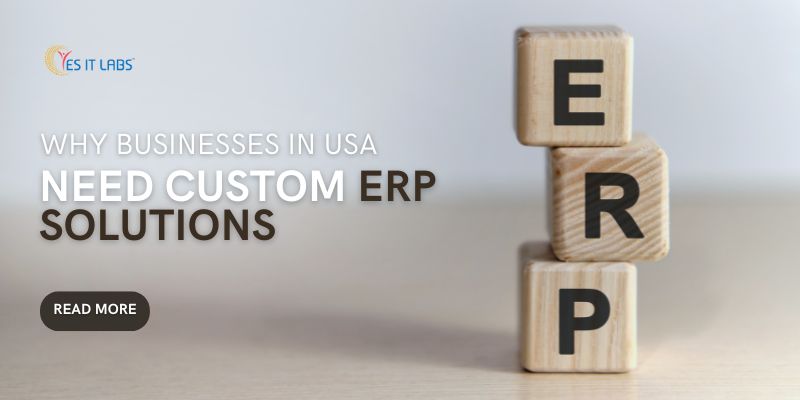
Running a business today means juggling sales data in one tool, inventory numbers in another, and financial reports in a third. For many American companies, this fragmented setup quietly drains hours every week and creates blind spots that hurt decision-making. That is exactly the gap a custom ERP solution is built to close.
Enterprise Resource Planning software has moved far beyond being a “nice to have” for large corporations. It has become a core operational requirement, and the numbers back this up. The United States is projected to generate roughly $28.77 billion in ERP software revenue in 2026, the highest of any country in the world. North America as a whole accounts for somewhere between 35% and 37.6% of global ERP spending, depending on the research firm. This is not a niche investment anymore; it is mainstream infrastructure for companies that want to stay competitive.
What Makes Custom ERP Different From Off-the-Shelf Software
A generic, out-of-the-box ERP system is built for the average business in a given industry. It assumes a workflow that may not match how your team actually operates. A custom ERP solution, on the other hand, is shaped around your specific processes, your reporting needs, and the systems you already rely on. This is why many companies now turn to a dedicated Software Development Services in USA provider rather than trying to force a generic license to fit their operations.
This distinction matters more than most business owners realize. According to recent market research, only about 3% of companies are satisfied relying on standard, out-of-the-box ERP functionality with no adjustments at all. Between 33% and 48% of businesses request moderate customization, and another 10% to 19% go further and ask for a fully personalized build. In other words, the overwhelming majority of organizations that adopt ERP software need at least some tailoring to make it genuinely useful.
The Real Reasons US Businesses Are Moving to Custom ERP
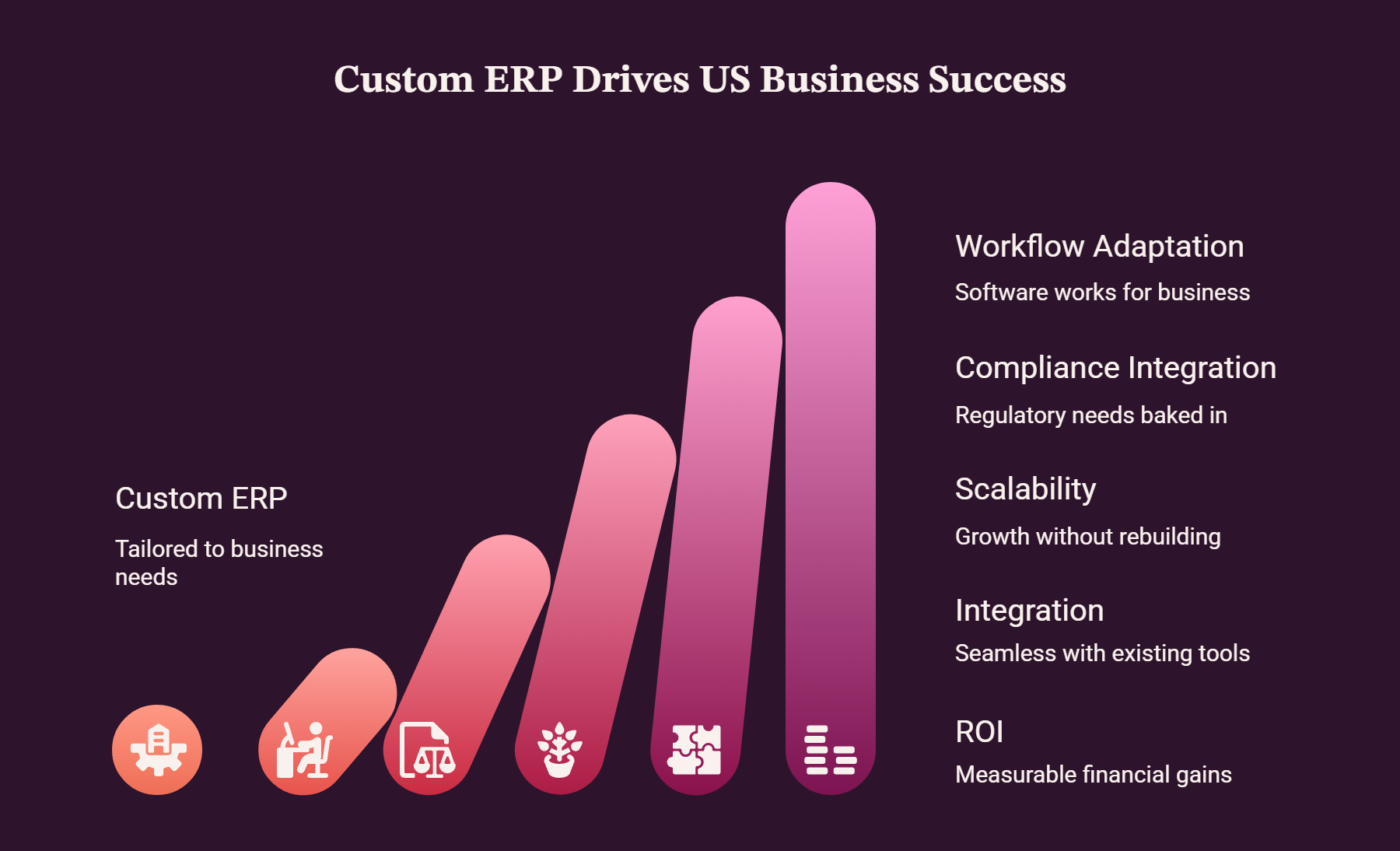
1. Generic Software Forces You to Change Your Workflow, Not the Other Way Around
Off-the-shelf platforms are designed to fit as many businesses as possible, which means they fit none of them perfectly. Teams end up working around the software instead of the software working for them. A custom build flips that relationship, so the system adapts to your existing operations rather than forcing a redesign of how your staff works.
2. Industry-Specific Compliance and Reporting Needs
US businesses operate under a wide range of regulatory frameworks depending on their sector, from healthcare data handling to financial reporting standards to manufacturing safety documentation. A custom ERP can be built with these specific compliance requirements baked into the workflow from day one, rather than retrofitted later. This is one reason manufacturing remains the leading ERP adopter, representing close to 47% of ERP purchasers, since production tracking, quality control, and supply chain documentation all demand a level of precision that generic software often cannot deliver. For manufacturers and distributors in particular, partnering with a Supply Chain Software Development Company can make the difference between a system that merely tracks inventory and one that actively prevents costly bottlenecks.
3. Scalability Without Starting Over
Many businesses choose a basic ERP system early on, only to outgrow it within a few years and face the painful process of migrating to something new. A custom solution is designed with growth in mind from the start, so new modules, locations, or business units can be added without rebuilding the entire system. This is part of why small and medium-sized enterprises are now the fastest-growing segment in cloud ERP adoption, with growth rates above 21% annually, since cloud-based custom builds finally make enterprise-grade scalability accessible to smaller companies.
4. Better Integration With Existing Tools
Most businesses already use a stack of tools such as CRM platforms, e-commerce systems, accounting software, and marketing automation. A custom ERP can be built to integrate cleanly with this existing stack, avoiding the duplicate data entry and disconnected reporting that come from forcing a one-size-fits-all system into an environment it was never designed for.
5. A Measurable Return on Investment
ERP adoption is not just a technology upgrade; it shows up directly on the balance sheet. Industry data shows that the average ROI for an ERP project sits around 52%, meaning businesses typically get back $1.52 for every dollar invested. Companies also report meaningful operational gains, including roughly 30% in cost savings within purchasing and inventory control, and an average 11% reduction in overall inventory costs. A custom solution tends to amplify these returns because it is solving the exact bottlenecks a business actually has, rather than generic ones.
The Shift Toward Cloud-Based Custom ERP
Cloud deployment has become the default choice rather than the exception. Cloud ERP adoption climbed to roughly 64% in 2024, up sharply from 44% just four years earlier, and over 78% of new ERP implementations now choose cloud-based architecture from the outset. For US businesses, this shift matters because cloud-based custom ERP removes the heavy upfront infrastructure cost that used to make tailored systems feel out of reach for smaller companies. Subscription-based pricing and remote accessibility mean a mid-sized business in Ohio or a logistics company in Texas can now access the same level of customization that was once reserved for Fortune 500 enterprises, often by working with an experienced ERP Software Development Services in USA team rather than building everything in-house.
Common Concerns Businesses Have Before Investing
It would be misleading to suggest custom ERP is a simple decision. Implementation timelines and budgets need realistic planning, since a mid-size ERP rollout averages around 17.4 months and often runs a few months past the original schedule. Data migration is consistently cited as the biggest challenge organizations face during implementation, followed closely by ongoing data entry accuracy. The businesses that succeed are the ones that plan for this upfront, choose an experienced development partner, and involve leadership throughout the process. Notably, 77% of companies that completed a successful ERP implementation pointed to strong institutional leadership support as the most critical success factor, more important than the software itself.
Is Custom ERP Worth It for Your Business
If your current systems require manual workarounds, your reporting takes days instead of minutes, or your software cannot keep pace with your growth, those are clear signals that a tailored solution is worth exploring. The data is fairly consistent across the industry: roughly 95% of businesses report measurable process improvements after implementing an ERP system, and two-thirds describe their implementation as successful or very successful.
A custom ERP solution is not about chasing a trend. It is about building the operational backbone that lets a US business run efficiently today and scale confidently tomorrow, without being held back by software that was never built for it in the first place. For many organizations, this kind of system is just one piece of a broader move toward Business Automation Solutions in USA that connect every department into a single, efficient operation.