
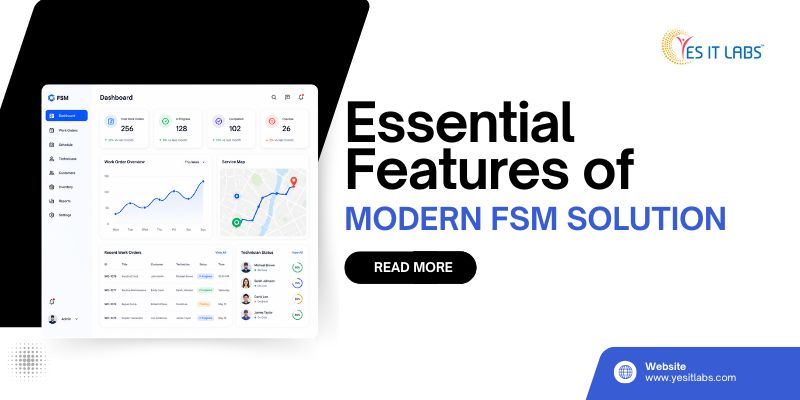
Field service businesses have always operated on the edge of complexity. Technicians in the field, work orders piling up, customers expecting faster responses, and back-office teams trying to keep everything synchronized. It’s a lot to manage without the right tools. That’s exactly why Field Service Management (FSM) software has gone from a “nice to have” to a genuine operational necessity.
And the numbers back this up. The global FSM market is projected to grow from $5.10 billion in 2025 to $9.17 billion by 2030, at a compound annual growth rate of 12.5%, driven by digital transformation, AI adoption, and rising customer expectations. Yet many businesses still rely on spreadsheets, phone calls, and paper-based work orders to run their field operations, leaving enormous efficiency gains on the table.
If you’re evaluating a field service management platform, or simply want to understand what a mature solution looks like, this guide breaks down every feature that matters and why it matters.
What Is Field Service Management Software?
At its core, FSM software is a platform that helps organizations plan, dispatch, track, and analyze the work performed by mobile technicians in the field. Think HVAC companies scheduling maintenance visits, telecom crews installing 5G equipment, medical device technicians servicing hospital equipment, or utilities teams managing infrastructure repairs.
The software connects the back office with field personnel in real time, replacing manual coordination with automated workflows, intelligent scheduling, and data-driven decision-making.
1. Intelligent Work Order Management
Work orders are the heartbeat of any field service operation. Every job starts with one, and how well that work order is created, assigned, tracked, and closed determines whether your service delivery runs smoothly or falls apart.
A modern FSM solution goes far beyond a basic ticket system. It allows dispatchers and managers to create detailed work orders that capture the full scope of a job: equipment details, service history, required parts, customer instructions, priority level, and estimated completion time. Technicians receive work orders on their mobile devices with all the context they need before even arriving on site.
What separates good work order management from great is automation. The best platforms can auto-generate work orders based on maintenance schedules, IoT alerts, or customer contracts, eliminating the manual entry bottleneck entirely. Work orders should also be linked to asset records, customer profiles, and inventory data so nothing falls through the cracks.
Why it matters: Incomplete or poorly managed work orders are a leading cause of repeat visits. Research shows that improving first-time fix rates is the top priority for over 60% of field service organizations, and that starts with thorough, well-structured work orders.
2. Smart Scheduling and Dispatch Optimization
Manual scheduling is one of the most resource-intensive tasks in field service operations, and one of the most error-prone. Assigning the wrong technician to a job, routing inefficiently, or failing to account for skill gaps wastes time, fuel, and customer goodwill.
Modern FSM platforms use AI-powered scheduling engines that factor in technician availability, skill sets, certifications, location, current workload, travel time, and parts availability to assign the right person to the right job at the right time. Some platforms offer drag-and-drop scheduling dashboards where dispatchers can visualize the entire team’s day in a single view, while more advanced systems can auto-schedule entire job queues with minimal human intervention.
Route optimization is equally important. By clustering geographically proximate jobs, platforms can reduce unnecessary truck rolls and travel time. Mordor Intelligence notes that field service routing algorithms can cut truck rolls by up to 20% by intelligently clustering nearby jobs, which translates to a significant saving in fuel costs and technician hours.
Why it matters: Nearly 45% improvement in technician utilization has been reported in pilot deployments of AI-based scheduling tools, according to Global Growth Insights. For businesses with large mobile workforces, that level of optimization translates directly to more jobs completed per day without adding headcount.
3. Real-Time Mobile Access for Field Technicians
Your field technicians are the ones actually delivering service. How well-equipped they are at the point of service determines everything from first-time fix rates to customer satisfaction scores. A modern FSM solution must have a robust, intuitive mobile application that works just as well in low-connectivity environments as it does on a strong network.
The mobile app should give technicians immediate access to:
- Full work order details and customer history
- Equipment manuals, diagrams, and troubleshooting guides
- Parts availability and inventory lookup
- Digital checklists and service forms
- Signature capture and photo documentation
- Real-time communication with the back office
Critically, the app must offer offline functionality. The U.S. mobile workforce is expected to reach 93.5 million workers, representing nearly 60% of the total workforce. Many of them operate in basements, remote areas, or sites with unreliable connectivity. Companies with robust mobile and remote access capabilities report 27% faster problem resolution times and 31% higher first-time fix rates compared to those with limited mobile access.
For businesses building or upgrading their mobile layer, investing in purpose-built Field Services Management App Development Solutions ensures the application is tailored to your technician workflows, industry-specific compliance requirements, and integration needs, rather than forcing teams to adapt to a generic interface.
4. Predictive Maintenance and Asset Management
Reactive maintenance, which means fixing something only after it breaks, is expensive and disruptive. Forward-thinking FSM platforms shift organizations toward a predictive model, where potential failures are identified and addressed before they cause downtime.
This is made possible by integrating FSM software with IoT sensors on equipment and assets. Sensors continuously monitor performance metrics like temperature, vibration, pressure, and cycle counts. When readings drift outside acceptable thresholds, the system automatically creates a work order and schedules a technician, often before the customer is even aware of a problem.
Asset management as a feature goes beyond predictive maintenance. It allows organizations to maintain a complete digital record of every asset they service: installation date, warranty status, maintenance history, part replacements, and associated service contracts. This single source of truth eliminates the frustrating situation where a technician arrives at a site with no idea what work was done there six months ago.
Why it matters: The demand for predictive maintenance is listed as the primary growth driver for the FSM market by Technavio. Organizations in industries like utilities, manufacturing, and healthcare, where equipment downtime carries serious financial and safety consequences, are investing heavily in this capability.
5. Scheduling and Inventory Management
Even the best technician can’t complete a job without the right parts. Inventory management within an FSM platform ensures that parts and supplies are tracked across warehouses, service vehicles, and remote stocking locations in real time.
A well-integrated inventory module enables technicians to check parts availability before heading to a job, flag low-stock items automatically, and trigger replenishment orders when thresholds are reached. It also allows for parts to be reserved against specific work orders, preventing the scenario where two technicians show up to separate jobs expecting the same part.
Integration with ERP and procurement systems is an important extension here. When a field team’s inventory data flows seamlessly into the company’s broader supply chain and financial systems, businesses gain full visibility into the cost of each job, better forecasting, and tighter control over margins. Organizations that lack in-house ERP expertise often partner with a specialized ERP development company in USA to build or configure the connectors needed to link their FSM platform with existing financial and supply chain systems effectively.
Industry signal: Integration capabilities expanded significantly in 2024, with nearly 57% of FSM platforms adding native ERP and CRM connectors to streamline service workflows and data consistency, according to Global Growth Insights.
6. Customer Communication and Self-Service Portals
Today’s customers expect the same visibility into service appointments that they get when tracking a package. They want to know who is coming, when they will arrive, and what was done. FSM solutions that include customer communication tools and self-service portals give service businesses a significant competitive advantage.
Core capabilities in this area include:
- Automated appointment confirmation and reminder messages via SMS or email
- Real-time technician tracking (like an Uber-style ETA view for service calls)
- Customer portals where clients can log service requests, view history, and track open tickets
- Digital service reports sent automatically upon job completion
- Post-service satisfaction surveys to capture feedback while it’s still fresh
These features reduce inbound calls to your support team, improve customer satisfaction scores, and create a more professional brand experience at every touchpoint.
7. Reporting, Analytics, and KPI Dashboards
Data without insight is just noise. A modern FSM platform collects enormous amounts of operational data, including job completion times, technician performance, SLA compliance, first-time fix rates, customer satisfaction scores, parts usage, and revenue per work order. The value of that data depends entirely on how well the platform surfaces it.
Leading platforms provide configurable dashboards that let managers track their most important KPIs at a glance, drill down into specific teams or time periods, and identify patterns that aren’t visible in day-to-day operations. Service managers should be able to answer questions like:
- Which technicians have the highest and lowest first-time fix rates?
- Which customers generate the most repeat service calls?
- What are our most common failure types by equipment model?
- Are we meeting our SLA commitments, and where are we falling short?
The operational impact of strong analytics is measurable. Dashboard customization initiatives have resulted in nearly 44% faster decision-making for service managers, according to market data from Global Growth Insights, which is a meaningful gain in fast-moving field operations environments.
8. Contract and SLA Management
Service agreements are the commercial backbone of many FSM-dependent businesses. Whether you’re managing preventive maintenance contracts, warranties, or enterprise service level agreements, the platform needs to track every obligation and alert the right people when deadlines approach.
Contract management features in modern FSM solutions typically include:
- Contract storage with associated assets, entitlements, and billing terms
- Automated SLA timers that trigger escalations if response or resolution times are at risk
- Entitlement checking to verify what a customer is covered for before sending a technician
- Revenue recognition tied to service contract milestones
Without this level of automation, SLA breaches often happen simply because no one was watching the clock. With it, the system watches for you and escalates accordingly.
9. Integration Capabilities
No FSM solution operates in isolation. It needs to connect with the broader technology ecosystem of the organization, including CRMs like Salesforce, ERP systems like SAP or Oracle, accounting platforms like QuickBooks, and increasingly, IoT platforms and smart building systems.
Deep integration ensures that data flows in both directions without manual re-entry. A new customer record created in the CRM appears automatically in the FSM platform. A completed job in the FSM system triggers an invoice in the accounting software. A sensor alert from an IoT platform creates a work order in the FSM queue.
The importance of this connectivity cannot be understated. Businesses that operate FSM in a silo, manually exporting data from one system to paste into another, lose hours each week to administrative tasks that should be automated, and introduce errors in the process. For organizations running Salesforce as their CRM backbone, it often makes sense to hire Salesforce API developers who can build and maintain robust, bidirectional data flows between Salesforce and the FSM platform, ensuring customer records, service history, and contract data stay perfectly synchronized across both systems.
10. AI and Automation Capabilities
Artificial intelligence has moved from buzzword to table stakes in enterprise FSM platforms. The practical applications are real and measurable, ranging from intelligent job assignment to predictive scheduling to automated anomaly detection.
Key AI-driven features in mature FSM platforms include:
- Automated job assignment that routes work orders without dispatcher intervention, based on real-time conditions
- Predictive parts ordering that anticipates demand based on maintenance schedules and historical usage
- Anomaly detection in IoT-connected assets that triggers proactive service before failures occur
- Natural language interfaces that let technicians update job status by voice, reducing screen time in the field
- Performance benchmarking that identifies underperformance patterns in technician productivity
The investment in AI capabilities is accelerating. The FSM market’s growth is increasingly tied to AI integration, and more than 68% of service organizations are currently prioritizing automation, while nearly 72% are focused on improving workforce productivity through digital tools, according to recent market data.
11. Compliance and Safety Management
Field service work often takes place in regulated environments such as electrical systems, medical facilities, oil and gas infrastructure, and food processing plants. Technicians must follow specific safety protocols, carry required certifications, and maintain documentation that proves compliance with industry standards.
A modern FSM platform supports compliance by:
- Verifying technician certifications before job assignment
- Enforcing mandatory checklists and sign-offs at key job stages
- Capturing timestamped photo evidence of work completed
- Generating compliance-ready reports for audits
- Alerting managers when certifications are approaching expiration
The regulatory compliance software market is growing rapidly, projected to reach $12.46 billion in 2025, reflecting how seriously service-dependent industries are taking the documentation and enforcement of compliance standards.
12. Cloud-Based Architecture and Security
The infrastructure on which FSM software runs has direct implications for reliability, scalability, and security. Cloud-based deployment has become the dominant model, and for good reason: it eliminates on-site server maintenance, enables automatic updates, and allows field teams to access the platform from anywhere.
Nearly 59% of organizations now prefer cloud-based FSM deployment to enable real-time workforce coordination and remote access. Around 67% of service teams using cloud platforms report faster job closure rates, while 63% highlight improved collaboration between field and back-office staff.
On the security side, FSM platforms handle sensitive customer data, asset information, and in some cases, access credentials for critical infrastructure. Vendors have responded accordingly, with approximately 49% of vendors introducing multi-layer authentication and data encryption features in 2024 to address rising security concerns.
How to Choose the Right FSM Solution
With so many platforms on the market, ranging from enterprise giants like Salesforce Field Service, Microsoft Dynamics 365, and Oracle Field Service to mid-market and SMB-focused tools, the selection process can feel overwhelming. A few key questions help narrow the field:
What industries do you primarily serve? Some platforms are purpose-built for specific verticals like HVAC, utilities, or healthcare and come with industry-specific workflows, compliance checklists, and terminology baked in.
What is your team size? SMEs and large enterprises have very different needs. Cloud-based solutions designed for small teams offer rapid deployment and low cost of entry, while enterprise platforms offer deeper customization and integration but require more implementation effort.
How complex is your scheduling environment? If you’re managing dozens of technicians with overlapping skill requirements and SLA commitments, you’ll need a sophisticated scheduling engine. If you’re dispatching ten people to straightforward jobs, a simpler tool may serve you well.
What does your existing tech stack look like? Integration requirements are often the deciding factor. A platform that plays nicely with your existing CRM, ERP, and accounting tools will deliver value far faster than one requiring custom development work.
The Business Case for Investing Now
The gap between organizations using modern FSM software and those still relying on manual processes is widening every year. As customer expectations rise, labor becomes more expensive, and competitive pressures intensify, the operational advantages of intelligent field service management become harder to ignore.
The market’s growth trajectory reflects this urgency. The U.S. market alone was valued at $2.1 billion in 2024 and is projected to reach $6.6 billion by 2032, and the global picture of consistent double-digit growth driven by AI, IoT, and cloud adoption makes the direction of travel unmistakably clear.
Businesses that invest in a mature, feature-complete FSM solution today are building the operational foundation for a more productive, more responsive, and more profitable field service organization tomorrow.