
Project management has become significantly more complex than it was just a few years ago. Organizations are managing distributed teams, digital transformation initiatives, customer-centric projects, regulatory requirements, and rapidly changing market demands all at the same time. As businesses grow, the need for better visibility, collaboration, and operational efficiency becomes increasingly critical.
While many organizations initially adopt popular project management tools, they often discover that generic solutions cannot fully support their unique workflows and business objectives. Features that work well for one company may create limitations for another, forcing teams to rely on manual workarounds, disconnected systems, and inefficient processes.
This growing gap between business requirements and standard software capabilities is driving a major shift toward custom project management software. Companies are no longer viewing project management platforms as simple productivity tools. Instead, they see them as strategic business assets capable of improving efficiency, reducing costs, enhancing collaboration, and supporting long-term growth.
In 2026, businesses across industries are investing in customized project management solutions that align perfectly with their operations, integrate seamlessly with existing systems, and leverage emerging technologies such as artificial intelligence and automation.
The Growing Complexity of Modern Projects
Modern projects involve far more moving parts than traditional project management models were designed to handle. Teams often work across different locations, departments, and time zones while collaborating on multiple projects simultaneously.
The rise of hybrid work environments has further increased the demand for centralized project visibility. Managers need real-time updates, accurate resource allocation, and clear communication channels to keep projects on track.
At the same time, organizations face increasing pressure to deliver projects faster while maintaining quality and controlling costs. Customers expect quicker turnaround times, stakeholders demand greater transparency, and leadership teams rely on data-driven insights to guide strategic decisions.
As project complexity continues to grow, businesses require solutions that can adapt to their specific workflows rather than forcing them into predefined processes.
Why Generic Project Management Tools No Longer Meet Business Needs
Off-the-shelf project management software provides a convenient starting point, but it often struggles to meet the evolving needs of growing organizations.
Lack of Workflow Flexibility
Every business operates differently. A software development company follows entirely different project processes than a healthcare provider, manufacturing enterprise, or construction firm.
Generic software is built for mass adoption, which means businesses often have to modify their internal processes to fit the tool. Over time, this creates inefficiencies, user frustration, and productivity bottlenecks.
Custom project management software eliminates this problem by aligning technology with existing business operations.
Integration Challenges
Today’s organizations depend on multiple business systems to function efficiently. Customer relationship management platforms, ERP systems, accounting software, HR applications, and communication tools all play critical roles.
When project management software cannot integrate effectively with these systems, data becomes fragmented. Teams waste valuable time switching between platforms, manually updating records, and reconciling inconsistent information.
Scalability Limitations
Business growth often exposes the limitations of standard software solutions. Additional users, new departments, expanding workflows, and increasing project volumes can quickly strain systems that were not designed for long-term scalability.
Custom solutions can be developed with future growth in mind, ensuring they continue to support business objectives as organizational needs evolve.
Key Reasons Businesses Are Investing in Custom Project Management Software
Organizations increasingly recognize that customized solutions provide advantages that extend far beyond project tracking.
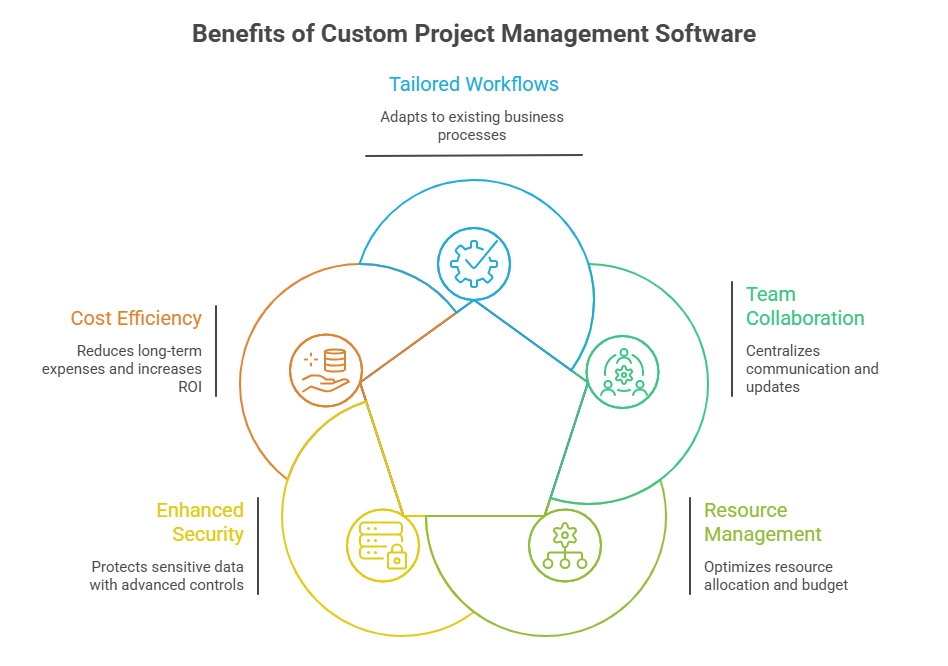
Tailored Workflows That Match Business Operations
One of the most significant benefits of custom software is its ability to reflect the way a business actually works.
Rather than forcing teams to adapt to rigid processes, custom platforms support existing workflows, approval structures, reporting requirements, and operational procedures. This improves user adoption and reduces the learning curve associated with software implementation.
Better Team Collaboration and Visibility
Effective collaboration remains one of the most important factors in project success.
Custom project management platforms can centralize communication, documentation, task management, and project updates within a single environment. Team members gain immediate visibility into responsibilities, deadlines, dependencies, and project progress.
This transparency helps eliminate communication gaps and improves accountability across departments.
Improved Resource and Budget Management
Resource allocation remains a major challenge for organizations of all sizes. Without accurate visibility into team workloads and project demands, businesses often experience resource shortages, scheduling conflicts, or budget overruns.
Custom software provides real-time insights into resource utilization, capacity planning, project costs, and budget performance, enabling more informed decision-making.
Enhanced Security and Compliance
As cyber threats continue to increase, organizations must take a proactive approach to protecting sensitive business information.
Custom project management solutions can incorporate advanced security controls, role-based permissions, encryption standards, and compliance requirements specific to the industry.
This level of customization provides greater protection than many generic software platforms can offer.
Long-Term Cost Efficiency
Although custom software typically requires a larger initial investment, it often delivers greater value over time.
Businesses can avoid recurring licensing fees, eliminate unnecessary features, reduce operational inefficiencies, and maintain complete ownership of the platform.
The result is a solution that generates measurable returns through improved productivity and operational performance.
Custom vs Off-the-Shelf Project Management Software
The differences between custom and standard project management solutions become increasingly important as organizations scale.
| Feature | Off-the-Shelf Software | Custom Project Management Software |
| Customization | Limited | Fully tailored to business needs |
| Scalability | Restricted by vendor plans | Designed for future growth |
| Integration Capabilities | Often limited | Seamless system integration |
| Security Controls | Standardized | Customized security framework |
| Ownership | Subscription-based | Full ownership and control |
| Competitive Advantage | Shared functionality | Unique business-specific features |
For many organizations, the ability to create a solution tailored to their operations becomes a key competitive advantage.
How AI Is Transforming Custom Project Management Software
Artificial intelligence is redefining how organizations manage projects, resources, and business operations.
Companies investing in AI Software Development Services are increasingly incorporating intelligent capabilities into project management platforms to improve efficiency and decision-making.
AI-powered systems can analyze historical project data, identify risks before they become problems, and recommend corrective actions based on predictive insights.
Project managers can use AI to forecast project timelines more accurately, optimize resource allocation, and automate repetitive administrative tasks. Intelligent assistants can generate reports, track progress, schedule meetings, and prioritize work based on business objectives.
Predictive analytics also helps organizations identify patterns that impact project success. By analyzing past performance, AI can anticipate delays, budget risks, and resource conflicts before they affect project outcomes.
As artificial intelligence continues to evolve, custom project management software is becoming increasingly proactive rather than reactive, helping businesses make smarter decisions faster.
Real-World Use Cases Across Industries
Software Development
Software companies rely heavily on project management platforms to coordinate agile workflows, sprint planning, quality assurance, and product releases.
A specialized Project Management Software Development Company can create solutions that integrate development tools, automate workflows, and improve collaboration between development, testing, and product teams.
Manufacturing
Manufacturers often manage complex production schedules, supply chain operations, inventory planning, and workforce allocation.
Integrating project management capabilities with Custom ERP Software Development Services allows manufacturers to gain complete visibility across operational processes while improving efficiency and reducing production delays.
Healthcare
Healthcare organizations must manage projects while complying with strict regulatory requirements.
Custom project management solutions help coordinate teams, monitor compliance activities, streamline workflows, and maintain accurate documentation throughout project lifecycles.
Construction
Construction projects involve numerous stakeholders, contractors, timelines, budgets, and compliance requirements.
Custom software enables real-time project tracking, resource scheduling, budget monitoring, and document management, reducing delays and improving project outcomes.
Why Businesses Partner with a Custom Software Development Company
Developing a successful project management platform requires technical expertise, strategic planning, and a deep understanding of business processes.
Many organizations work with a Custom Software Development Company in USA to build scalable, secure, and future-ready project management solutions tailored to their unique requirements.
Experienced development partners help businesses identify operational challenges, define project requirements, design intuitive user experiences, and implement advanced technologies such as artificial intelligence, cloud infrastructure, and workflow automation.
Beyond development, they also provide ongoing maintenance, support, and future enhancements that ensure long-term software success.
Future Trends Shaping Project Management Software
The future of project management software will be heavily influenced by emerging technologies and evolving workplace expectations.
Generative AI is expected to automate many project planning activities, including task creation, documentation, risk assessments, and project reporting.
Real-time business intelligence will provide leaders with instant access to actionable insights, helping them make more informed decisions.
Low-code and no-code capabilities will allow organizations to customize workflows more quickly without extensive development resources.
Integrated ecosystems that connect project management, ERP, CRM, and customer service platforms will continue to gain popularity as businesses seek unified operational visibility.
Organizations that embrace these innovations will be better positioned to improve efficiency, accelerate growth, and maintain a competitive advantage.
Conclusion
The increasing complexity of modern business operations is driving a fundamental shift in how organizations approach project management. While traditional software solutions can provide basic functionality, they often fail to address the unique workflows, integration requirements, scalability demands, and security expectations of growing businesses.
Custom project management software offers a more strategic approach. By aligning technology with business processes, organizations can improve collaboration, optimize resource utilization, automate repetitive tasks, strengthen security, and gain deeper visibility into project performance. The addition of artificial intelligence further enhances these capabilities by enabling predictive planning, intelligent automation, and data-driven decision-making.
As digital transformation continues to accelerate, businesses are investing in customized solutions that provide flexibility and long-term value. Organizations that adopt tailored project management platforms today will be better equipped to manage complexity, improve operational efficiency, and achieve sustainable growth in an increasingly competitive marketplace.
Frequently Asked Questions
1. Why is custom project management software better than off-the-shelf solutions?
Custom software is built specifically around a company’s workflows, processes, and business objectives, providing greater flexibility, scalability, and efficiency than generic solutions.
2. How does AI improve project management software?
Artificial intelligence enhances project management through predictive analytics, automated task management, intelligent resource allocation, risk forecasting, and real-time reporting.
3. Can custom project management software integrate with ERP and CRM systems?
Yes. Custom solutions can seamlessly integrate with ERP platforms, CRM systems, accounting software, HR applications, and other business tools to create a unified operational ecosystem.
4. Which industries benefit the most from custom project management software?
Industries such as software development, healthcare, manufacturing, construction, logistics, finance, and professional services benefit significantly from customized project management solutions.
5. How do businesses choose the right development partner?
Businesses should evaluate industry experience, technical expertise, portfolio strength, security practices, scalability capabilities, and long-term support services when selecting a software development partner.