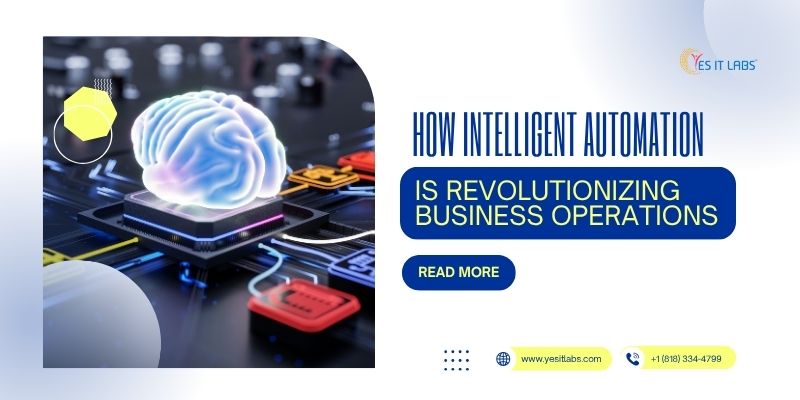
In today’s highly competitive digital economy, businesses are under constant pressure to improve efficiency, reduce costs, and deliver exceptional customer experiences. Traditional automation has helped organizations streamline repetitive tasks, but a new wave of technology is taking operational excellence to the next level: Intelligent Automation (IA).
By combining Artificial Intelligence (AI), Machine Learning (ML), Robotic Process Automation (RPA), Natural Language Processing (NLP), and advanced analytics, intelligent automation is transforming how businesses operate, make decisions, and serve customers.
Organizations across industries, including healthcare, finance, manufacturing, and retail, are embracing intelligent automation to increase productivity, reduce human error, and unlock new growth opportunities.
What Is Intelligent Automation?
Intelligent Automation is the integration of AI-powered technologies with automation tools to automate not only routine tasks but also complex business processes that require decision-making, learning, and adaptation.
Unlike traditional automation, which follows predefined rules, intelligent automation can:
- Analyze large volumes of data
- Learn from patterns and behaviors
- Make data-driven recommendations
- Understand human language
- Adapt to changing business conditions
- Continuously improve performance
This enables organizations to automate both structured and unstructured workflows while improving accuracy and efficiency.
The Growing Adoption of Intelligent Automation
The demand for intelligent automation continues to accelerate worldwide.
According to industry research:
- Nearly 80% of organizations are investing in automation technologies to improve operational efficiency.
- Businesses implementing intelligent automation often report productivity improvements of 20% to 40%.
- Customer service automation can reduce response times by more than 50%.
- Organizations leveraging AI-driven automation frequently experience significant reductions in operational costs.
These trends demonstrate that intelligent automation is no longer a future concept. It is becoming a core component of modern business strategy.
As organizations continue their digital transformation efforts, many executives are focusing on the Benefits of Business Process Automation to improve operational efficiency, reduce manual workloads, and create more scalable business models. These advantages are driving increased investments in intelligent technologies across industries.
Key Technologies Behind Intelligent Automation
Artificial Intelligence (AI)
AI enables systems to mimic human intelligence by analyzing data, recognizing patterns, and making decisions.
Common AI applications include:
- Predictive analytics
- Fraud detection
- Customer behavior analysis
- Demand forecasting
- Personalized recommendations
To fully leverage AI capabilities, many organizations partner with providers offering AI Software Development Services in USA to build customized solutions that align with their operational goals, customer expectations, and long-term growth strategies.
Robotic Process Automation (RPA)
RPA automates repetitive, rule-based tasks such as:
- Data entry
- Invoice processing
- Report generation
- Employee onboarding
- Order management
Software bots can perform these tasks faster and more accurately than manual processes.
Machine Learning (ML)
Machine learning allows systems to improve automatically through experience.
Businesses use ML for:
- Sales forecasting
- Risk assessment
- Predictive maintenance
- Inventory optimization
- Customer segmentation
Natural Language Processing (NLP)
NLP enables machines to understand and respond to human language.
Examples include:
- AI chatbots
- Virtual assistants
- Automated email responses
- Sentiment analysis
- Voice-enabled customer support
Intelligent Document Processing (IDP)
IDP uses AI and OCR technologies to extract, classify, and process information from documents.
Organizations use IDP to automate:
- Contracts
- Insurance claims
- Medical records
- Tax forms
- Financial statements
How Intelligent Automation Is Transforming Business Operations
1. Streamlining Repetitive Processes
Many business operations involve repetitive tasks that consume valuable employee time.
Intelligent automation handles activities such as:
- Data collection
- Data validation
- Form processing
- Workflow approvals
- Scheduling
This allows employees to focus on strategic, higher-value work rather than administrative tasks.
2. Improving Operational Efficiency
One of the most significant benefits of intelligent automation is increased efficiency.
Automated systems can:
- Operate 24/7
- Process information instantly
- Eliminate workflow bottlenecks
- Accelerate turnaround times
- Reduce manual intervention
As a result, organizations can achieve more with fewer resources while maintaining high-quality output.
3. Enhancing Decision-Making
Business leaders rely on accurate information to make informed decisions.
Intelligent automation supports decision-making by:
- Analyzing real-time data
- Identifying trends
- Predicting future outcomes
- Detecting anomalies
- Providing actionable insights
This enables faster and more confident decision-making across departments.
4. Reducing Human Error
Manual processes often lead to mistakes that can impact productivity, compliance, and customer satisfaction.
Automation improves accuracy by:
- Standardizing workflows
- Validating data automatically
- Enforcing business rules
- Monitoring transactions continuously
The result is greater consistency and fewer costly errors.
5. Delivering Better Customer Experiences
Modern customers expect fast, personalized, and seamless interactions.
Intelligent automation enhances customer experience through:
- AI-powered chatbots
- Personalized recommendations
- Automated support systems
- Faster issue resolution
- Omnichannel communication
Businesses can provide immediate assistance while maintaining a consistent customer experience across all touchpoints.
Industry Applications of Intelligent Automation
Healthcare
Healthcare organizations use intelligent automation for:
- Patient scheduling
- Medical billing
- Claims processing
- Electronic health record management
- Diagnostic support
These solutions help reduce administrative burdens and improve patient care.
Financial Services
Banks and financial institutions leverage automation to:
- Detect fraud
- Process loans
- Verify customer identities
- Automate compliance reporting
- Conduct risk assessments
This improves security while accelerating service delivery.
Manufacturing
Manufacturers utilize intelligent automation for:
- Predictive maintenance
- Quality control
- Supply chain management
- Production planning
- Inventory optimization
The result is reduced downtime and improved operational efficiency.
Retail and E-Commerce
Retailers apply automation to:
- Demand forecasting
- Inventory management
- Customer support
- Dynamic pricing
- Personalized marketing
These capabilities help businesses improve customer satisfaction while increasing profitability.
Modern automation initiatives often depend on seamless connectivity between multiple business platforms. This is where Third Party API Integration Services play a critical role, enabling organizations to connect CRM systems, ERP platforms, payment gateways, cloud applications, and customer support tools into a unified ecosystem.
Human Resources
HR departments use intelligent automation for:
- Resume screening
- Employee onboarding
- Payroll processing
- Performance tracking
- Workforce analytics
This streamlines HR operations and improves employee experiences.
Major Benefits of Intelligent Automation
Increased Productivity
Employees spend less time on repetitive work and more time on strategic initiatives.
Cost Reduction
Automation reduces labor-intensive activities, operational expenses, and costly errors.
Scalability
Businesses can handle growing workloads without proportionally increasing staffing requirements.
Improved Compliance
Automated systems maintain detailed audit trails and enforce regulatory requirements consistently.
Faster Business Processes
Organizations can significantly reduce processing times and improve service delivery.
Better Employee Satisfaction
By eliminating repetitive tasks, employees can focus on more meaningful and rewarding work.
Challenges Organizations Should Consider
While intelligent automation offers substantial benefits, implementation requires careful planning.
Common challenges include:
Integration Complexity
Legacy systems may require modernization before automation can be fully deployed.
Data Quality Issues
Automation depends on accurate, structured, and accessible data.
Change Management
Employees may need training and support to adapt to new workflows and technologies.
Cybersecurity Risks
Automated systems must be protected against data breaches and cyber threats.
Initial Investment
Although long-term savings are significant, implementation may require upfront technology investments.
Organizations that address these challenges proactively typically achieve stronger automation outcomes.
Future Trends in Intelligent Automation
The next generation of intelligent automation is expected to include:
Hyperautomation
Hyperautomation combines AI, RPA, analytics, and process mining to automate entire business ecosystems.
Generative AI Integration
Businesses are increasingly integrating generative AI tools to create content, summarize information, automate communications, and support decision-making.
Autonomous Business Processes
Advanced AI systems will eventually manage increasingly complex workflows with minimal human intervention.
Predictive and Prescriptive Analytics
Organizations will move beyond understanding what happened to predicting future events and recommending optimal actions.
Human-AI Collaboration
Rather than replacing employees, intelligent automation will continue to augment human capabilities and improve workplace productivity.
Best Practices for Implementing Intelligent Automation
To maximize success, organizations should:
- Identify high-impact automation opportunities.
- Start with well-defined processes.
- Ensure strong data governance.
- Establish measurable KPIs.
- Involve stakeholders early.
- Provide employee training.
- Continuously monitor and optimize workflows.
- Scale automation gradually based on proven results.
Organizations planning large-scale automation initiatives should also evaluate their technology partners carefully. Investing in Business Automation Software Development can help companies build tailored solutions that address unique workflows, compliance requirements, and industry-specific operational challenges.
Conclusion
Intelligent automation is fundamentally changing the way businesses operate. By combining artificial intelligence, machine learning, robotic process automation, and advanced analytics, organizations can streamline operations, reduce costs, improve decision-making, and deliver superior customer experiences.
As technology continues to evolve, intelligent automation will play an increasingly important role in helping businesses remain competitive, agile, and innovative. Companies that invest in automation today are positioning themselves for greater efficiency, stronger growth, and long-term success in the digital era.
The question is no longer whether businesses should adopt intelligent automation, but how quickly they can leverage it to gain a competitive advantage.