
Manufacturing companies are operating in an increasingly complex environment. Supply chain disruptions, fluctuating customer demands, rising operational costs, and evolving compliance requirements have made traditional business management approaches insufficient. To remain competitive, manufacturers need intelligent systems that can streamline operations, improve visibility, and support data-driven decision-making.
Enterprise Resource Planning (ERP) systems have long served as the backbone of manufacturing operations. However, as technology advances and business needs become more specialized, many organizations find that standard ERP platforms alone cannot address every operational challenge. This is where custom ERP augmentation solutions come into play.
ERP augmentation enhances existing ERP systems by integrating advanced functionalities, automation capabilities, analytics tools, and industry-specific modules. These customized solutions empower manufacturers to optimize workflows, improve operational efficiency, and gain greater control over every aspect of production and business management.
This article explores how custom ERP augmentation solutions are transforming the manufacturing sector, the benefits they offer, key implementation challenges, emerging trends, and practical use cases that demonstrate their value.
Understanding ERP Augmentation in Manufacturing
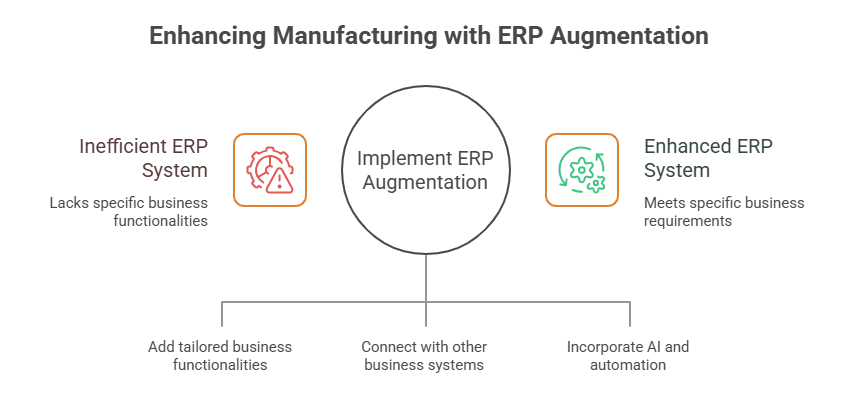
ERP augmentation refers to the process of extending and enhancing existing ERP systems with customized features, integrations, and intelligent technologies that address specific business requirements.
Rather than replacing an entire ERP infrastructure, manufacturers can enhance current systems by adding functionalities such as:
- Real-time production monitoring
- Predictive maintenance
- AI-powered analytics
- Supply chain visibility tools
- Advanced reporting dashboards
- Warehouse automation modules
- Customer and vendor management enhancements
By leveraging ERP Software Development Services, manufacturers can create tailored solutions that align perfectly with their operational goals and business processes.
Why Traditional ERP Systems Often Fall Short
While conventional ERP platforms provide a strong foundation, manufacturing businesses frequently encounter limitations as they scale.
Limited Customization
Many off-the-shelf ERP systems are designed to serve multiple industries. As a result, they may lack features required for specific manufacturing environments.
Data Silos
Manufacturers often use separate applications for inventory management, logistics, procurement, and production planning. These data silos create inconsistencies and reduce operational visibility.
Inadequate Real-Time Insights
Modern manufacturing requires instant access to operational data. Legacy ERP systems may struggle to deliver real-time insights quickly enough for effective decision-making.
Difficulty Adapting to Market Changes
Rapid shifts in customer demands and supply chain conditions require flexible systems capable of adapting to market changes.
ERP augmentation addresses these challenges by creating a more agile and scalable ecosystem.
Key Components of Custom ERP Augmentation Solutions
Advanced Manufacturing Intelligence
Modern ERP enhancements provide real-time visibility into production processes through connected machinery, sensors, and IoT devices.
Manufacturers can monitor:
- Equipment performance
- Production output
- Downtime incidents
- Quality control metrics
- Resource utilization
This level of insight enables proactive decision-making and continuous process improvement.
Enhanced Inventory Management
Inventory inefficiencies can significantly impact profitability. Excess stock ties up capital, while shortages delay production schedules.
Custom Inventory Management Software Development solutions integrated with ERP systems allow manufacturers to:
- Track inventory in real time
- Automate stock replenishment
- Forecast demand accurately
- Reduce carrying costs
- Minimize stockouts
With accurate inventory visibility, organizations can improve operational efficiency while maintaining optimal stock levels.
Supply Chain Integration
Supply chain disruptions remain one of the biggest concerns for manufacturers worldwide.
ERP augmentation can integrate suppliers, distributors, warehouses, and logistics providers into a unified ecosystem. This creates greater transparency and improves collaboration across the entire supply chain network.
Predictive Analytics and Business Intelligence
Advanced predictive analytics tools embedded within ERP platforms help businesses transform raw operational data into actionable insights.
Benefits include:
- Demand forecasting
- Production planning optimization
- Risk identification
- Cost reduction opportunities
- Revenue growth analysis
These insights support stronger business intelligence and strategic planning.
The Growing Importance of ERP Augmentation in Manufacturing
The manufacturing industry is rapidly embracing digital transformation initiatives.
According to industry research, manufacturers implementing intelligent automation and advanced analytics technologies report significant improvements in productivity, operational efficiency, and customer satisfaction. Companies that successfully integrate digital technologies often outperform competitors in profitability and market responsiveness.
As Industry 4.0 adoption accelerates, ERP augmentation is becoming a strategic investment rather than simply a technological upgrade.
Key drivers include:
- Increasing automation requirements
- Rising customer expectations
- Global supply chain complexity
- Data-driven decision-making needs
- Workforce productivity demands
Organizations that modernize their ERP ecosystems position themselves for long-term success in an increasingly competitive market.
Major Benefits of Custom ERP Augmentation Solutions
Improved Operational Efficiency
Automation reduces manual processes, eliminates redundancies, and accelerates workflow execution.
Teams spend less time on administrative tasks and more time focusing on strategic initiatives.
Better Decision-Making
Access to real-time information allows leadership teams to make faster and more informed decisions.
Comprehensive dashboards provide visibility across departments, helping organizations identify opportunities and address issues proactively.
Increased Productivity
Automated workflows streamline daily operations, enabling employees to work more efficiently.
Production schedules, procurement activities, and inventory updates can be managed with minimal manual intervention.
Enhanced Customer Satisfaction
Faster order processing, improved product availability, and accurate delivery timelines contribute to a better customer experience.
Organizations can respond quickly to customer demands while maintaining consistent service quality.
Scalability and Flexibility
Custom ERP augmentation solutions evolve alongside business growth.
Manufacturers can add new features, integrations, and capabilities without disrupting existing operations.
Real-World Use Cases of ERP Augmentation
Smart Factory Operations
A manufacturing company operating multiple production facilities implemented IoT-enabled ERP enhancements to monitor machine performance in real time.
Results included:
- Reduced equipment downtime
- Improved production efficiency
- Faster maintenance response times
- Higher product quality consistency
Demand-Driven Inventory Optimization
A consumer goods manufacturer integrated predictive analytics into its ERP platform.
The system analyzed historical sales patterns, seasonal demand fluctuations, and supplier lead times to optimize stock levels.
Outcomes included:
- Lower inventory holding costs
- Reduced stock shortages
- Improved order fulfillment rates
End-to-End Logistics Visibility
A large manufacturing enterprise partnered with specialists offering Logistics Software Development Services to integrate transportation management capabilities into its ERP environment.
The augmented solution enabled:
- Real-time shipment tracking
- Route optimization
- Delivery performance monitoring
- Transportation cost reduction
As a result, the company improved supply chain efficiency while enhancing customer satisfaction.
Emerging Trends Shaping ERP Augmentation
Artificial Intelligence Integration
Artificial Intelligence (AI) is transforming ERP systems into intelligent decision-support platforms.
Manufacturers can leverage AI for:
- Demand forecasting
- Predictive maintenance
- Quality inspection
- Production optimization
- Customer behavior analysis
Cloud-Based ERP Enhancements
Cloud-based ERP enhancements provide greater scalability, flexibility, and accessibility.
These solutions allow organizations to:
- Reduce infrastructure costs
- Improve collaboration
- Enable remote access
- Accelerate system updates
Internet of Things (IoT)
The Internet of Things (IoT) generates valuable operational data that can be integrated directly into ERP systems.
IoT-driven ERP augmentation supports:
- Real-time monitoring
- Asset tracking
- Predictive maintenance
- Production automation
Low-Code and No-Code Development
Manufacturers increasingly seek rapid customization capabilities.
Low-code and no-code development platforms enable organizations to deploy new workflows, dashboards, and business applications faster than traditional development methods.
Challenges Manufacturers Face During ERP Augmentation
While ERP augmentation offers substantial benefits, successful implementation requires careful planning.
Integration Complexity
Connecting multiple systems, applications, and data sources can present significant integration complexity.
Data Migration Risks
Poor-quality data can negatively impact performance, making data migration a critical phase of implementation.
User Adoption Resistance
Employees may hesitate to embrace new technologies and workflows. Strong user adoption strategies are essential for success.
Security and Compliance Concerns
Manufacturers handle sensitive operational and customer data.
ERP augmentation projects must incorporate robust security and compliance measures to protect critical information.
Best Practices for Successful ERP Augmentation
Define Clear Business Objectives
Organizations should establish clear business objectives before beginning any augmentation initiative.
Choose the Right Technology Partner
Working with the right technology partner ensures customized solutions align with manufacturing requirements and long-term goals.
Prioritize Scalability
Future growth should be considered during the design phase, making scalability a core requirement.
Focus on Data Accuracy
Reliable data accuracy forms the foundation of successful ERP performance and analytics.
Implement Incrementally
An incremental implementation approach reduces risk and allows teams to adapt gradually.
Measuring ERP Augmentation Success
Manufacturers should establish measurable Key Performance Indicators (KPIs) to evaluate project outcomes.
Common KPIs include:
- Production efficiency improvements
- Inventory turnover rates
- Order fulfillment accuracy
- Downtime reduction
- Customer satisfaction scores
- Supply chain performance metrics
- Cost savings
Continuous monitoring ensures organizations maximize the value of their ERP investments.
Conclusion
The manufacturing industry is undergoing a profound digital transformation, and ERP augmentation has emerged as a powerful strategy for achieving operational excellence. By extending existing ERP systems with advanced technologies, intelligent automation, predictive analytics, and industry-specific capabilities, manufacturers can overcome traditional limitations and unlock new levels of efficiency, agility, and growth.
Whether improving production visibility, optimizing inventory control, enhancing supply chain collaboration, or leveraging AI-powered insights, custom ERP augmentation solutions enable businesses to remain competitive in an increasingly complex marketplace.
Companies that invest in tailored ERP enhancements today will be better equipped to navigate future challenges, capitalize on emerging opportunities, and achieve sustainable long-term success.
Ready to Modernize Your Manufacturing Operations?
If your organization is looking to modernize your manufacturing operations, maximize efficiency, improve operational visibility, and accelerate digital transformation, partnering with experts in custom ERP solutions can make all the difference.
Invest in a tailored ERP augmentation strategy that aligns with your business objectives, strengthens competitiveness, and empowers your manufacturing operations for the future.